The global baby sleeping bag market is growing steadily, driven by rising safety awareness among parents and the shift away from loose blankets in infant sleep environments. For B2B buyers — whether you're a private label brand, a retail chain buyer, or an importer — sourcing the right baby sleeping bag manufacturer requires navigating a very specific set of technical and compliance requirements.
Based on industry search data and professional sourcing patterns, this article addresses the five most frequently asked questions from B2B buyers searching for baby sleeping bag suppliers — and what you should expect from a qualified manufacturer.
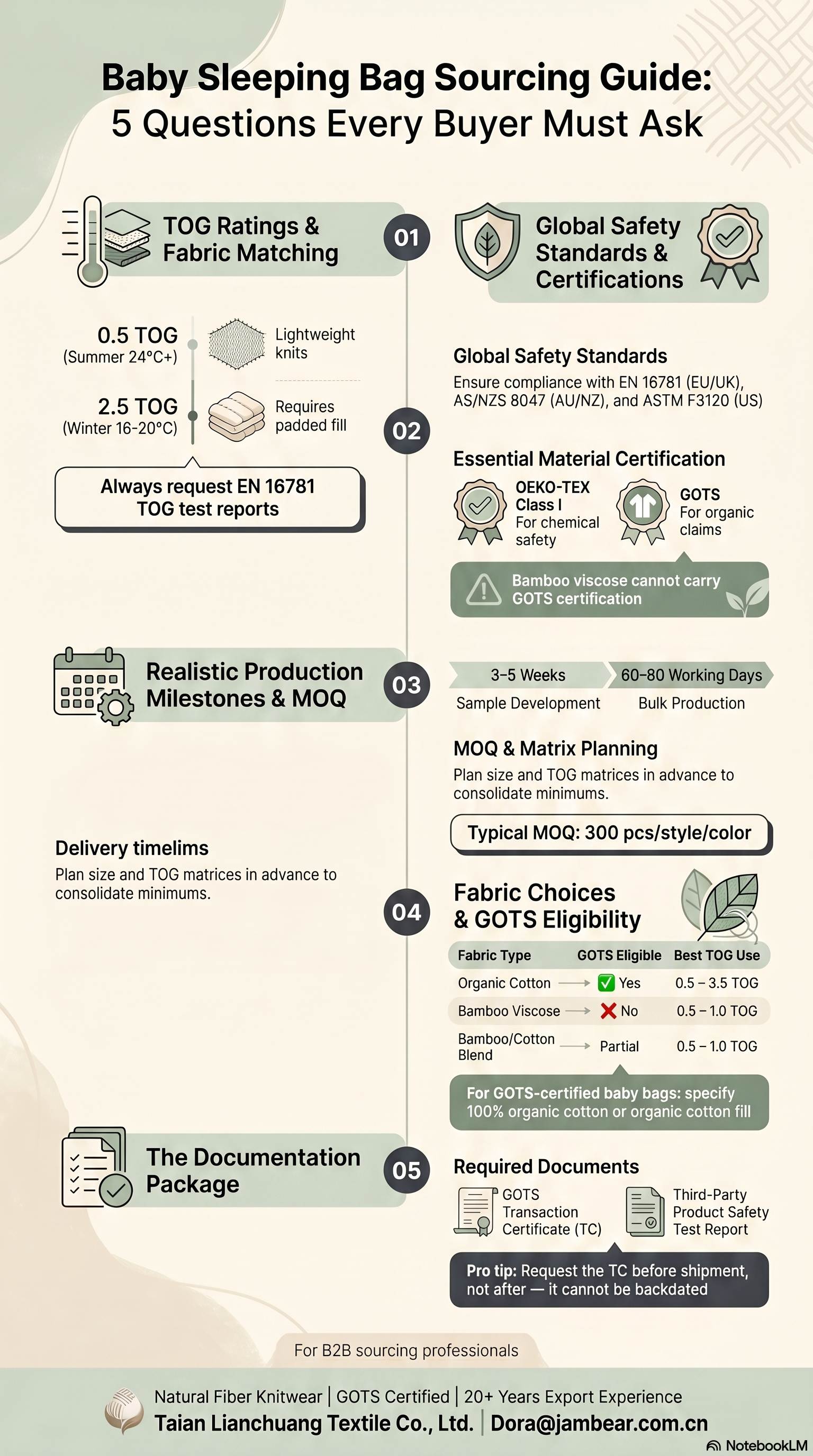
Q1: What TOG Rating Options Are Available, and How Does That Affect Fabric and Fill Selection?
TOG (Thermal Overall Grade) is the single most critical technical specification for baby sleeping bags. It determines the thermal resistance of the product and directly governs fabric weight, fill type, and construction method. For B2B buyers, understanding TOG options is the foundation of product development.
Standard TOG Ranges in the Market
What to Ask Your Supplier
- What fill material is used for 2.5 and 3.5 TOG products — polyester fiberfill, organic cotton batting, or recycled fill?
- Can they provide test reports confirming TOG rating (EN 16781 for EU markets)?
- Is the TOG independently tested or calculated internally?
For natural fiber brands: Bamboo viscose and organic cotton are well-suited for 0.5–1.0 TOG lightweight sleeping bags. For higher TOG ratings, the fill and lining choices become critical differentiators.
Q2: What Safety Standards and Certifications Are Required — and Can the Supplier Meet Them?
Infant product safety is non-negotiable. B2B buyers — especially those selling into the EU, UK, Australia, or North America — face a layered compliance environment covering both product safety standards and material/chemical certifications.
Key Safety Standards by Market
Material & Chemical Certifications That Matter
- GOTS (Global Organic Textile Standard): If marketing as organic, GOTS certification is essential. It covers the full supply chain from fiber to finished garment. Note: GOTS applies to organic cotton and natural fibers — bamboo viscose (a regenerated fiber) is outside GOTS scope.
- OEKO-TEX STANDARD 100 Class I: The most stringent class, specifically for baby and infant products. Tests for 100+ harmful substances including formaldehyde, heavy metals, and banned azo dyes.
- BSCI / SMETA / SA8000: Social compliance audits increasingly required by EU and Australian retailers.
Questions to Ask Your Supplier
- Have their baby sleeping bag designs been tested against EN 16781 / AS/NZS 8047?
- Can they provide current GOTS scope certificates and Transaction Certificates (TC) per shipment?
- Is their bamboo or conventional fiber sourced from an OEKO-TEX Class I certified mill?
- Do they have a current BSCI or equivalent social audit report?
Q3: What Is the MOQ, Lead Time for Samples, and Bulk Production Timeline?
For B2B buyers at the development or scaling stage, production logistics are as important as product specs. Delays in sampling or unclear MOQ policies can derail seasonal launch windows.
Typical Industry Benchmarks
MOQ Considerations for Baby Sleeping Bags
Baby sleeping bag programs typically require multi-size and multi-TOG matrix planning, which increases complexity. A standard range might cover sizes (0–6M / 6–18M / 18–36M), TOG ratings (0.5 / 1.0 / 2.5), and 3–5 colors per season.
This means buyers should negotiate MOQ per style/color/size rather than per SKU, and discuss whether the manufacturer can consolidate minimums across a color range.
Typical MOQ from specialized natural fiber knitwear manufacturers: 300 pieces per style per color. Smaller quantities are usually negotiable for sample programs prior to bulk, often credited against the first bulk order.
Key Questions to Ask
- What is the MOQ per style / per color? Can sizes be combined within an MOQ?
- What is your current sample lead time for padded sleeping bags vs. lightweight single-layer?
- What deposit is required to begin production, and what is the payment structure?
- Do you provide weekly production progress updates during bulk?
Q4: What Fabric and Fill Options Are Available for Natural Fiber or Sustainable Baby Sleeping Bags?
Sustainability is no longer a niche positioning — it is a baseline expectation for baby brands in the EU, UK, Australian, and North American premium markets. B2B buyers increasingly need to source baby sleeping bags that support credible eco and health claims.
Organic Cotton
GOTS certifiable — the strongest organic claim available in textiles. Ideal for both lightweight (single jersey, 160–180gsm) and padded constructions. Breathable, hypoallergenic, and suitable for all TOG ranges when combined with appropriate fill.
Bamboo Viscose
Exceptionally soft — well-suited for newborn skin sensitivity. Naturally breathable and moisture-wicking; excellent for 0.5–1.0 TOG summer bags. Not certifiable under GOTS, but OEKO-TEX Class I certified bamboo fiber provides strong safety documentation. Bamboo/cotton blends (e.g., 70/30) combine softness with GOTS-eligibility.
Fill Options for Padded (2.5–3.5 TOG) Sleeping Bags
What to Ask Your Supplier
- Can you produce in 100% organic cotton with GOTS certification from fiber to finished garment?
- What bamboo viscose brands or mills do you source from — do they hold OEKO-TEX Class I?
- For padded sleeping bags, what fill options support an organic or sustainable product claim?
- Can you accommodate custom fabric blends (e.g., 60/40 bamboo/organic cotton) at volume?
Q5: Can You Provide Private Label, Custom Design, and Full Compliance Documentation Support?
For brand owners, the manufacturer relationship extends well beyond production. B2B buyers — especially those launching or growing a baby brand — need a supplier capable of delivering not just the product, but the full commercial and compliance package.
Private Label and OEM Capabilities to Look For
- Label and branding: Woven labels, printed care labels, hangtags — manufactured to your specifications in your brand identity
- Custom sizing: Ability to grade to your size chart rather than a standard chart
- Packaging: Polybag, gift box, or retail-ready packaging with your branding
- Design development (ODM): If you do not have tech packs, a qualified supplier should be able to develop from a brief, mood board, or reference garment
Compliance Documentation Package
For baby sleeping bags specifically, the compliance documentation requirements are more demanding than for adult apparel. A professional supplier should be able to provide:
Red Flags to Watch For
- Suppliers claiming GOTS certification for bamboo viscose products (bamboo viscose cannot be GOTS certified)
- Unable to provide current (not expired) certificates
- Unwilling to submit to third-party inspection or factory audit
- No prior experience with EN 16781 or infant product safety testing
Summary: What to Look for in a Baby Sleeping Bag B2B Supplier
About Taian Lianchuang Textile Co., Ltd.
A China-based natural fiber knitwear manufacturer with over 20 years of international brand supply experience. We specialize in bamboo viscose, organic cotton, and natural fiber blend knitwear for OEM and ODM programs.
Our certifications include: GOTS (Certificate No. ETK-00040564-GOTS-2603, valid to March 2027), BSCI, and bamboo fiber sourced from OEKO-TEX STANDARD 100 Class I certified mills.
We supply baby apparel programs to brands in the EU, UK, Australia, and North America, and provide full compliance documentation support including GOTS Transaction Certificates per shipment.
Ready to Source Baby Sleeping Bags?
Contact us to discuss your program requirements — TOG range, certifications, MOQ, and private label support. GOTS certified, BSCI audited, low MOQ from 300 pcs.
Request a Sample →