This article walks through the Lullaby Trust's guidance on baby sleeping bags section by section. For each point, we've tried to do three things: state what the guidance actually says, explain what we think it means in practical terms, and describe what it requires of a factory that takes it seriously.
Who Is the Lullaby Trust, and Why Does Their Guidance Matter
Before reading any guidelines, it's worth understanding who wrote them and why.
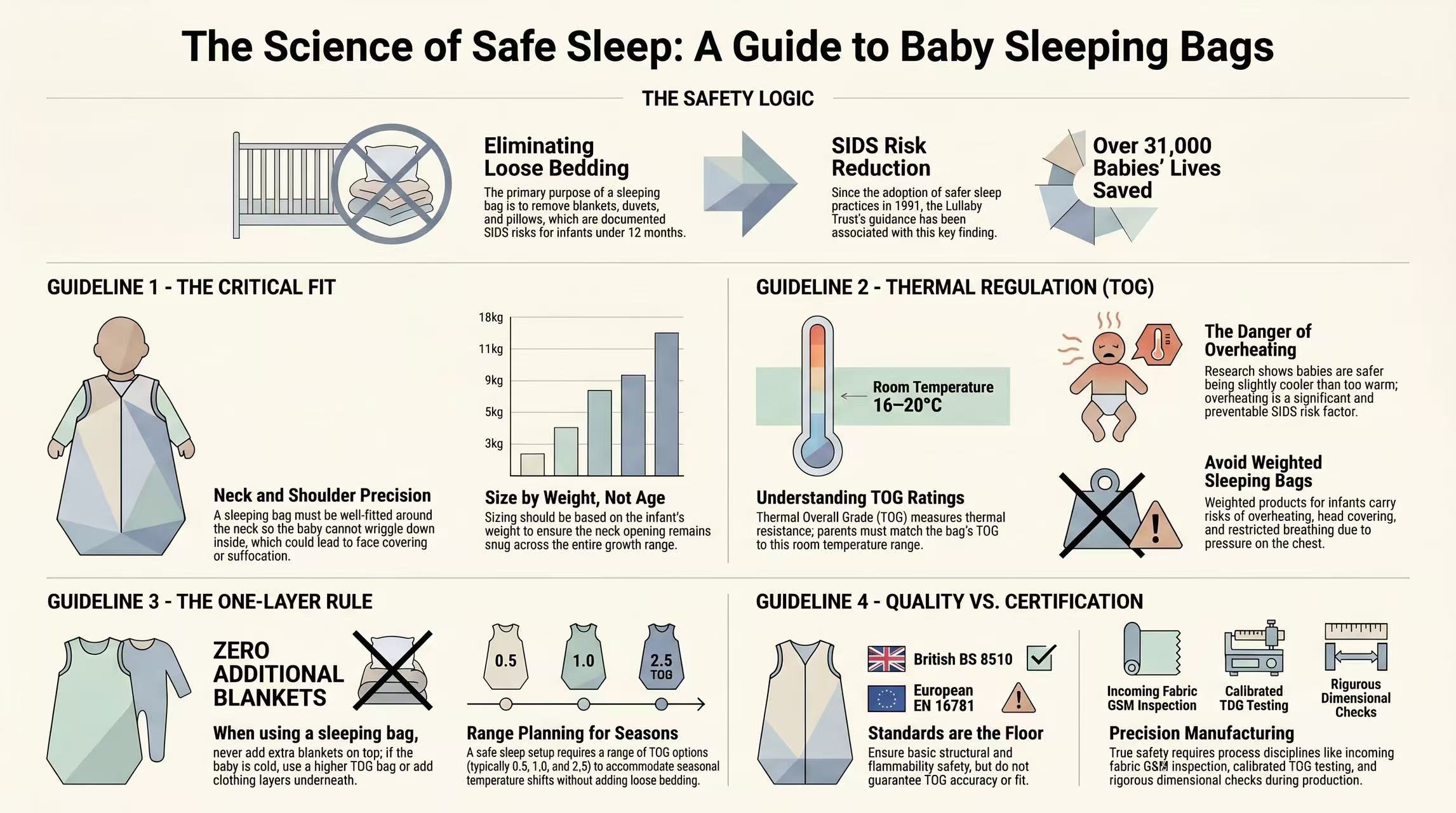
The Lullaby Trust is a UK-based charity whose work centres on sudden infant death syndrome — SIDS, previously called cot death. They fund research, support bereaved families, and publish evidence-based guidance for parents and caregivers. Their safer sleep advice has been associated with saving over 31,000 babies' lives since 1991. That number reflects a genuine public health shift: SIDS rates in the UK declined dramatically following the adoption of safer sleep practices in the 1990s.
They do not sell products. They do not generally recommend individual brands. Their guidance is not a marketing tool for anyone — including us. When they say something works, it is because the research says so. When they say something is risky, the same applies.
We've been reading and working to this guidance for over sixteen years. It is, in our experience, the most practically useful framework for understanding what a baby sleeping bag actually needs to do — and why.
The Baseline: Why Sleeping Bags Exist in This Context
To understand the Lullaby Trust's specific guidance on sleeping bags, it helps to understand the problem they're solving.
One of the central findings in SIDS research is that loose bedding in a baby's sleep environment — blankets, duvets, pillows — significantly raises risk. The mechanism is straightforward: a baby who cannot yet reposition themselves can have their face covered by a shifted blanket, leading to overheating or obstructed breathing. Infants in the first months of life do not have the motor control to move a blanket away from their face.
The Lullaby Trust's summary guidance states that the safest sleep environment for a baby is a clear, flat, firm sleep space — a cot or Moses basket with a waterproof mattress, and nothing else that isn't necessary. Blankets and duvets for babies under twelve months are specifically discouraged.
A sleeping bag solves this problem by eliminating loose bedding entirely. Because the bag is worn on the body, it cannot shift to cover the face. This is the core reason the Lullaby Trust recommends sleeping bags as an alternative to loose bedding — not because sleeping bags are inherently magical, but because they remove a specific, documented risk.
Guideline One: Fit Around the Neck and Shoulders
What the Lullaby Trust says: Their guidance states that a sleeping bag must be "well fitted around the neck and shoulders, so the baby can't wriggle down inside." They also note that most sleeping bags are fitted by weight, not by age, and that parents should always check the manufacturer's guidelines on sizing.
What this means: The neck opening is the critical safety dimension of a sleeping bag. If it is too large, a baby can slip down into the bag, which creates exactly the face-covering risk the bag is supposed to prevent. The guidance is specific because the failure mode is specific.
The weight-based sizing note is significant. Babies of the same stated age can vary considerably in size, and a bag sized for a "0–6 month" range needs to fit safely across the full weight distribution within that range — not just the average baby at four months. A bag that fits well at 5kg but has an oversized neck opening at 4kg represents a safety gap, even if it passes standard sizing checks at the midpoint.
What this requires from a factory: Pattern development for a well-fitting sleeping bag is more complex than it appears. The neck opening must be large enough to allow comfortable dressing and undressing while remaining snug enough at the shoulder that a smaller baby within the size range cannot slip through. Getting this balance right across a weight range requires multiple fitting trials, not just dimensional measurement against a spec sheet.
Our pattern archives for baby sleeping bags go back over fifteen years. The current versions reflect accumulated fitting data from samples, client feedback, and production quality reviews. A factory developing this product from scratch will spend considerable time in iteration before arriving at a pattern that works consistently across the weight range.
Guideline Two: TOG Ratings and Overheating Risk
What the Lullaby Trust says: Their guidance states that the recommended room temperature for a baby's sleep environment is 16–20°C, and that parents should follow the manufacturer's TOG guide. They are explicit that the risk of SIDS is higher in babies who get too hot — research shows babies are safer being slightly cooler than too warm.
They also specifically state that weighted sleeping bags are not recommended for babies under one year. Their reasoning: weighted bags carry a risk of overheating, can cover the baby's head if they move inside the bag, and can restrict breathing by pressing on a baby's chest.
What this means: TOG — Thermal Overall Grade — tells a parent how warm a bag will keep their baby at a given room temperature. The system is useful precisely because it gives parents a way to make temperature decisions without guesswork. A bag that traps too much heat at the wrong room temperature is actively dangerous. The TOG value on the label must be accurate, and the fabric must behave in a way that supports appropriate thermal regulation.
The weighted bag guidance deserves particular attention. This is a product trend that emerged partly from adult wellness culture and was adapted for infant sleepwear. The Lullaby Trust's position is clear and based on specific risks. Any factory or brand developing weighted infant sleepwear for the European or UK market should understand that this guidance creates real commercial and reputational exposure.
What this requires from a factory: TOG accuracy in bulk production is a process control problem. The TOG value of a finished sleeping bag is determined primarily by the weight and distribution of filling — or by the thermal properties of the shell fabric in a lighter bag. In either case, consistency across a production run requires calibrated equipment and trained operators. A unit filled 10–15% below specification is not slightly warm — it is a meaningfully different product in terms of thermal performance.
Guideline Three: No Additional Blankets When Using a Sleeping Bag
What the Lullaby Trust says: Their cold weather guidance is direct: if you are using a baby sleeping bag, do not add extra blankets on top. If the bag is not warm enough, add an extra layer of clothing underneath, or choose a higher TOG bag.
What this means: This guideline reinforces the logic of the sleeping bag system — the bag is the bedding, not an addition to existing bedding — and places the burden of temperature management on TOG selection and layering of clothing, not on adding loose items to the sleep space.
What this requires from a factory: A buyer who sells only a 2.5 TOG bag is not well-positioned for year-round use in a warm climate. A complete range requires options across the relevant TOG spectrum for the target market. In the UK, 0.5, 1.0, and 2.5 TOG are typically considered the core range. A factory needs to be able to produce multiple TOG values within the same style, with consistent fit and quality across the range.
Guideline Four: Safety Standards Are a Floor, Not a Ceiling
What the Lullaby Trust says: A safety standard does not mean that a product helps to reduce the chance of SIDS — it means the product meets a minimum threshold of general safety, for example that it will not fall apart or catch fire easily. For sleeping bags specifically, BS 8510:2009 is the applicable standard (with EN 16781 as the European equivalent). But their framing is clear: the standard is a floor, not a measure of quality or safety in the fuller sense.
What this means: A sleeping bag that carries a BS 8510 or EN 16781 certification has been tested against specific dimensional, structural, and flammability criteria. It has not been tested to verify that the TOG rating is accurate, that the neck opening fits safely across the weight range, or that the construction is consistent across bulk production. A buyer who treats certification as a complete quality assurance answer is relying on something narrower than they may realise.
What this requires from a factory: Meeting EN 16781 requires ongoing testing and documentation. But the more important implication is that a factory serious about this product category needs quality systems that go beyond what the standard requires — incoming fabric inspection, in-process weight checks for filled products, finished goods dimensional checks, and a fit review process that uses physical fittings, not just measurements.
What Sixteen Years of Making This Product Has Taught Us
We started making baby sleeping bags when the category was new in Western markets. The brands we worked with at the time were building their understanding of what parents needed at the same time we were building our production knowledge. There was no established playbook. The pattern development, the TOG calibration, the fabric sourcing decisions — all of it was worked out through iteration.
The Lullaby Trust's guidance has been relatively stable over that time. The fundamentals of infant safe sleep do not change quickly. What has changed is our ability to meet those fundamentals reliably — in different fabrics, across different size ranges, for clients with different market requirements. That is not something that comes from reading guidelines carefully, though that helps. It comes from production history.
Developing a Baby Sleeping Bag Range?
If you want to understand how Lullaby Trust guidance translates into production decisions — fit patterns, TOG QC, fabric selection — we're glad to have that conversation. GOTS certified, BSCI audited, MOQ from 100 pcs.
View Our Manufacturing Capabilities →