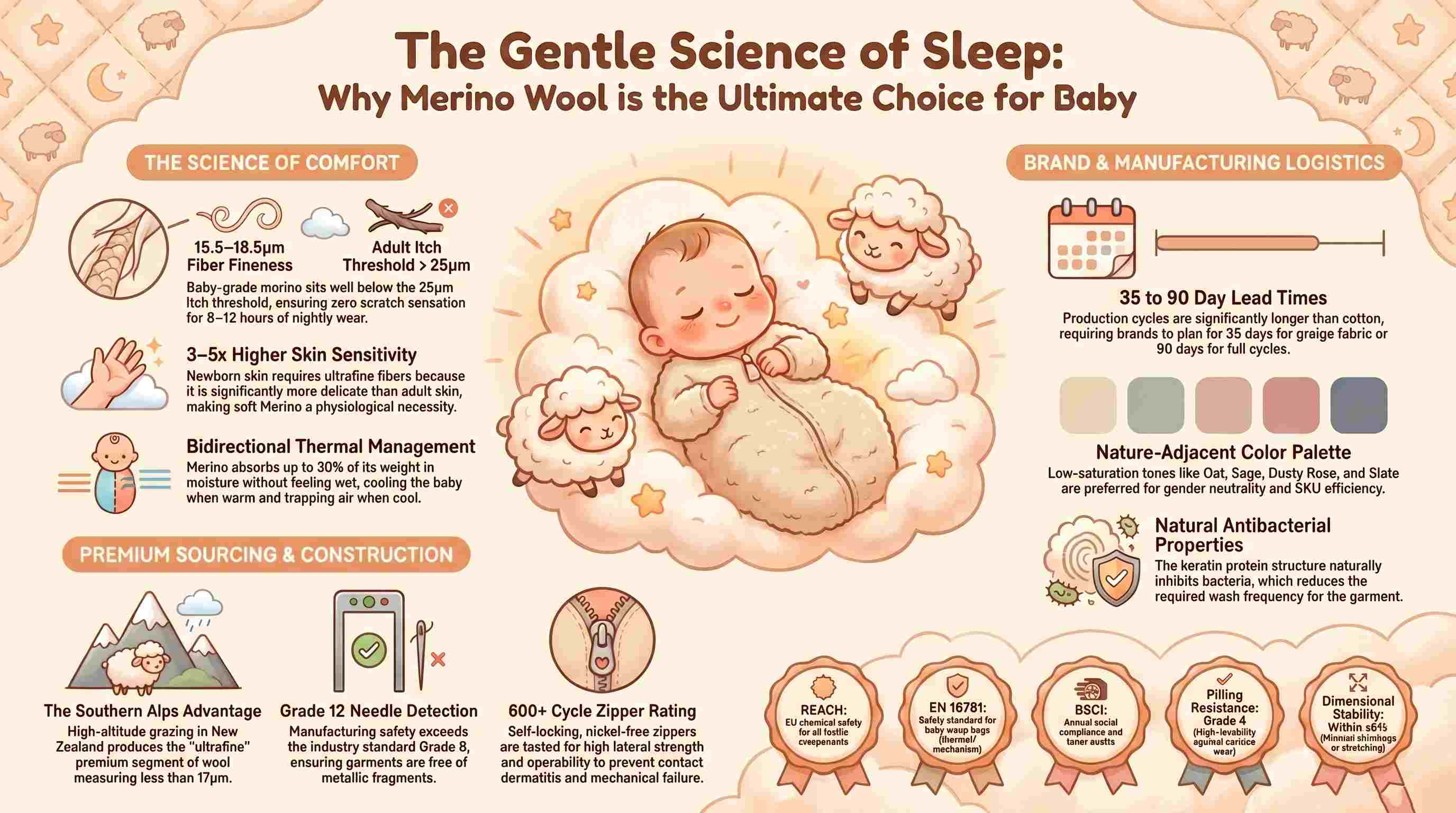
Few materials carry as much history, science, and genuine utility as merino wool — particularly when it comes to dressing the world's smallest, most demanding sleepers. At Lianchuang, we work with this fibre daily. This guide covers everything: where merino wool comes from, why it performs the way it does, how it became the fabric of choice for premium baby sleepwear, and what brands need to know when sourcing it responsibly.
Part One: The Animal Behind the Fibre
A Sheep Bred Over Centuries
The merino is not a wild animal. It is one of the most deliberately cultivated creatures in agricultural history — a sheep selectively bred over more than eight centuries for a single purpose: producing extraordinarily fine wool.
Its origins lie in the Iberian Peninsula. During the 12th and 13th centuries, the Kingdom of Castile developed a strain of sheep whose fleece was finer, softer, and more valuable than anything produced elsewhere in Europe. The wool trade that followed built fortunes in Florence, funded cathedrals in Bruges, and made the Spanish Crown one of the wealthiest monarchies in medieval Europe. For a time, exporting a live merino sheep from Spain was a capital offence. The animal was a state secret.
That changed in the late 18th century, when political pressures and shifting alliances allowed merino sheep to leave the Iberian Peninsula for the first time. What followed would reshape the global textile industry.
What Makes Merino Different
All sheep produce wool. What separates merino is a matter of physics, measured in micrometres (μm).
The diameter of a wool fibre determines how it interacts with human skin. Fibres above approximately 25μm are coarse enough to trigger the skin's mechanical itch receptors — the sensation most people associate with "scratchy wool." Merino wool, through centuries of selective breeding, consistently produces fibres in a dramatically finer range:
The fabric we work with for our baby sleepwear line measures 16.86μm — firmly in the Fine category, well below the threshold at which skin irritation occurs. For a newborn whose skin is three to five times more sensitive than an adult's, this distinction is not a marketing claim. It is physiology.
Part Two: Why Australia Became the World's Merino Capital
The Unlikely Geography of Luxury Wool
When merino sheep first arrived in Australia in 1797, transported by British colonists, nobody could have predicted that this southern continent would become the defining home of the world's finest wool. Yet the fit between animal and landscape turned out to be almost perfect.
Australia's interior — particularly the vast grasslands of New South Wales, Victoria, and South Australia — offered conditions that merino sheep thrive in:
Semi-arid climate. Low rainfall means dry fleece, fewer parasites, and slower vegetative growth that encourages sheep to roam widely. Wide-ranging flocks produce animals with stronger constitutions and, over generations, superior fleece.
Scale. Australia's landmass of 7.7 million square kilometres includes enormous tracts of land viable for little except grazing. A single Australian sheep station might span tens of thousands of hectares — a scale simply impossible in Europe or New Zealand's more fragmented, mountainous terrain.
Two centuries of selective breeding. Since 1797, Australian breeders have refined their merino flocks continuously, selecting for fibre fineness, fleece weight, and climate resilience. This accumulated genetic heritage cannot be replicated quickly. It is a genuine competitive advantage built over eight generations of farmers.
By the 19th century, Australian wool was the engine of the colonial economy. Today, Australia produces approximately 50% of the world's merino wool supply. The clip is auctioned in Sydney, Melbourne, and Fremantle, traded by brokers, and processed through a global supply chain that eventually reaches fabric mills and finished garment manufacturers across Asia and Europe.
New Zealand: The Ultrafine Premium
New Zealand produces far less merino wool by volume than Australia, but has carved out a distinct premium position in the market. The reason is geography of a different kind.
New Zealand's South Island merino sheep graze at high altitude in the Southern Alps — cold, exposed terrain that stresses the animals in ways that, paradoxically, produce exceptionally fine, dense fleece. New Zealand merino tends to cluster at the ultrafine end of the spectrum, below 17μm, making it particularly sought after for next-to-skin applications.
This is why several of the most recognised merino baby brands — founded in Christchurch, Queenstown, and Wellington — specifically market New Zealand provenance as a quality signal. Consumers in those markets understand what it means.
Part Three: From Heritage Textile to Performance Fabric
The Long Middle Period
For most of its history, merino wool was a luxury textile — fine suiting, high-end knitwear, expensive shirting. It was beautiful and expensive, but it was also fragile, slow to dry, and required careful handling. The outdoor and sportswear industries of the 20th century largely abandoned wool in favour of synthetic fibres: nylon, polyester, and later technical materials like Gore-Tex and Polartec.
The Icebreaker Moment: 1994
In 1994, a New Zealand entrepreneur named Jeremy Moon met a merino sheep farmer who had developed a fine-gauge merino fabric for outdoor use. The encounter led to the founding of Icebreaker — and the reimagining of merino wool as a high-performance technical fibre.
Icebreaker's insight was simple but transformative: merino's natural properties — temperature regulation, moisture management, odour resistance, softness — were not limitations to be overcome but advantages to be engineered. The problem had never been the fibre itself. It had been the processing.
With improved knitting technology, tighter gauge construction, and machine-washable treatments, merino wool became something it had never been before: a serious performance fabric. Smartwool, Patagonia, Arc'teryx, and dozens of other brands followed. By the mid-2000s, merino wool was established as the premium choice for base layers, travel clothing, and next-to-skin athletic wear.
The Baby Category: 2005 Onwards
The translation from adult performance wear to baby sleepwear followed naturally. The same properties that made merino ideal for hikers and skiers — thermal regulation, moisture wicking, antibacterial performance, softness — turned out to be precisely what parents of newborns needed.
Brands like Bambino Merino (founded in New Zealand in 2005) and Woolino (launched in 2010) pioneered the merino baby sleeping bag category specifically. They found a ready audience: parents who had already encountered merino in their own wardrobes, who understood the material's credentials, and who were willing to pay a significant premium for products they trusted to keep their babies comfortable through the night.
Today, wool represents approximately 8% of the global baby sleeping bag market — a figure that understates its commercial importance, because merino sits firmly at the premium end of the price spectrum. It is a small share by volume but a disproportionately large share by value.
Part Four: Why Merino Works for Baby Sleepwear
Temperature Regulation: The Core Benefit
A baby cannot regulate its own body temperature effectively. The risks of overheating and hypothermia are both real clinical concerns, not parental anxiety. Merino wool's fibre structure — a complex protein that can absorb up to 30% of its own weight in moisture vapour without feeling wet — creates a natural buffer against temperature extremes.
When a sleeping baby is warm, merino wicks moisture away from the skin and allows it to evaporate, producing a cooling effect. When the environment is cool, the same fibre traps a thin layer of warm air close to the body. No synthetic material replicates this bidirectional thermal management as naturally.
This is what the TOG (Thermal Overall Grade) rating system measures. TOG quantifies a sleeping bag's resistance to heat flow: lower TOG for warmer conditions, higher TOG for cooler rooms. A well-constructed merino sleeping bag achieves its TOG rating through the inherent properties of the fibre rather than added synthetic insulation — which is a meaningful distinction for parents who want natural materials throughout.
Antibacterial and Odour Resistant
The same protein structure that gives merino its softness — keratin, with a complex scale structure — inhibits bacterial growth naturally. Bacteria require moisture and a suitable surface to proliferate; merino's moisture-management properties and its scale structure deny them both. The practical result is that merino baby sleepwear requires less frequent washing than cotton equivalents, a genuine benefit for sleep-deprived parents dealing with a newborn.
Soft Enough for Newborn Skin
At 16.86μm, the merino fibre we use is below the threshold at which any sensation of scratch or itch occurs. It can be worn directly against a newborn's skin — including the most sensitive areas around the neck, wrists, and ankles — without irritation. This is a non-negotiable requirement for a sleepsuit or sleeping bag that will be in direct skin contact for eight to twelve hours every night.
Part Five: The Finished Product — Construction Details That Matter
Fabric Construction
Merino baby sleepwear is typically constructed from circular-knit jersey or interlock fabric. Interlock — a double-knit construction — provides greater dimensional stability, better recovery after washing, and a smoother surface on both faces. For sleeping bags, a single-layer or double-layer construction is used depending on the target TOG rating.
Typical fabric weight for baby sleepwear falls between 180 and 240 gsm. Below this range, the fabric lacks sufficient body. Above it, the garment becomes too heavy and warm for anything except the coldest sleeping environments.
Zippers: A Detail That Cannot Be Overlooked
A sleeping bag or sleepsuit zipper is in constant contact with baby skin. This makes material selection critical.
We specify nickel-free zippers as standard for all baby products. Nickel is one of the most common causes of contact dermatitis in infants, and any zipper component — slider, pull tab, teeth — that contains nickel represents an unnecessary risk. Our zipper test reports confirm the absence of nickel across all components.
Beyond nickel content, zipper performance for baby products requires:
- Operability — the force required to open and close the zip must be low enough for one-handed operation during night feeds (our testing shows 2.50N, well within the 4N standard)
- Self-locking — the slider must stay where it is placed without creeping open (tested to 47.8N, against a 20N standard)
- Durability — rated for a minimum of 600 open/close cycles
- Lateral strength — the zipper must resist being pulled apart; our testing shows 796.3N against a 380N standard
These are not marketing specifications. They are tested values from third-party laboratory reports.
Needle Detection
All metal components in our baby products pass through a needle detection system at Grade 12 — exceeding the standard Grade 8 requirement. Broken needle fragments are a genuine product safety risk, and detection at this sensitivity provides appropriate assurance.
Part Six: Colours, Aesthetics, and Market Positioning
Why the Palette Looks the Way It Does
Premium merino baby products share a recognisable colour aesthetic: oat, sage, dusty rose, slate, warm white, stone, and similar low-saturation, nature-adjacent tones. This is not accidental, and it is not simply fashion.
Several forces converge to produce this palette:
Brand coherence. The merino baby category positions itself around natural materials, transparency, and considered consumption. Saturated synthetic colours carry visual associations that contradict this positioning. Low-saturation tones read as "natural" within the visual language that this consumer category has developed — a convention that, once established, becomes self-reinforcing.
Gender neutrality. A product that works for any baby regardless of sex has a larger addressable market, works across siblings, and has stronger resale value. Neutral tones satisfy this requirement completely.
Photography and social commerce. The primary discovery channel for most merino baby brands is Instagram and Pinterest. Low-saturation tones photograph beautifully in natural light, on linen backgrounds, with minimal styling. Saturated colours require more controlled photographic conditions and rarely produce the same aesthetic result.
SKU efficiency. Seven well-chosen neutral colours cover virtually the entire target market's aesthetic preferences. More colours mean more inventory, more complexity, and more risk of deadstock.
From a manufacturing perspective, this colour palette is also practical: neutral tones dye consistently, show less batch-to-batch variation, and are less sensitive to minor colour-fastness variations between production runs.
Part Seven: Compliance and Testing
Understanding What Certifications Apply — and to What
One of the most common areas of confusion in the baby product supply chain is the relationship between different certifications and what they actually certify. It is worth being precise.
GOTS (Global Organic Textile Standard) certifies that a textile product is made from organic fibres and processed without prohibited chemicals, with audited social standards throughout the supply chain. GOTS applies to organic fibres — primarily cotton, linen, and hemp. Merino wool, even when produced on carefully managed farms, is not eligible for GOTS certification. A merino product can be excellent, well-tested, and responsibly sourced without being GOTS-certified — because GOTS simply does not cover wool.
For organic cotton baby products, Lianchuang holds a valid GOTS Scope Certificate (Certificate No. ETK-00040564-GOTS-2603, valid to March 2027), covering babies' apparel in both 100% organic cotton and 95-99% organic cotton / 1-5% elastane constructions. This allows us to issue GOTS Transaction Certificates for individual orders, permitting brands to use the GOTS label on finished products.
REACH is the European Union's chemical safety regulation, covering restricted substances across all textiles regardless of fibre type. For merino baby products destined for EU markets, REACH compliance testing — covering heavy metals, azo dyes, formaldehyde, phthalates, and related substances — is the relevant requirement. This testing is conducted on finished garments by accredited third-party laboratories and is arranged on a per-order basis.
EN 16781 is a European standard specifically governing the safety of baby sleeping bags used in cots. It covers thermal resistance (the scientific basis for TOG ratings), mechanical hazards, and strangulation risks. For our sleeping bag line, we have conducted EN 16781 thermal resistance testing (Clause 4.4), with a measured Rct of 0.0337 m²·K/W — well within the permitted maximum.
BSCI (Business Social Compliance Initiative) audits are conducted annually at our facility, covering labour conditions, health and safety, environmental management, and ethical business practices.
What Our Merino Fabric Testing Covers
For our merino wool fabric, we hold Chinese national standard (GB/T) test reports covering:
- Fibre composition and diameter — confirmed 100% merino, mean fibre diameter 16.86μm
- Colour fastness to washing — Grade 4 colour change, Grade 4-5 staining (Compliant under FZ/T 73018-2021)
- Colour fastness to rubbing — Dry rubbing Grade 4-5, wet rubbing Grade 4-5 (Compliant)
- Pilling resistance — Grade 4 (Compliant)
- Dimensional stability under steam pressing — Warp -1.6%, Weft +0.4% (within ±5% standard)
For brands requiring EU or international market certification, we coordinate third-party REACH testing through accredited laboratories. Testing scope and cost are confirmed based on target market and specific product requirements.
Part Eight: Working with a Manufacturer
What Brands Should Know Before Sampling
For new brands launching a merino baby line, a few practical points are worth establishing early:
Lead times are longer than cotton. Merino yarn supply chains involve seasonal raw material, specialised spinning, and careful dyeing — typically using disperse dye processes under high temperature and pressure, separate from any fabric dyeing. From yarn procurement to finished fabric, allow 35 days if greige fabric is available, or up to 90 days for a full production cycle. Planning ahead is not optional.
MOQ and colour selection interact. Each colour requires a separate dye run, with minimum volumes. Understanding how your initial order distributes across colours and sizes will determine your actual cost per unit. Neutral tones that carry over across seasons give brands more flexibility than fashion-led colours.
Sample confirmation requires clear specifications. Fabric weight, fibre diameter, knit structure, zip placement, fold-over mitten construction, care label requirements, and packaging — each detail resolved at the sample stage prevents expensive revisions at bulk production.
Compliance costs should be budgeted from the start. For brands new to the EU or other regulated markets, third-party compliance testing is a real line item. It is not a barrier — it is a business requirement that protects both the brand and its customers. Discussing this at the inquiry stage, rather than after sampling, produces better outcomes for everyone.
Conclusion
Merino wool's journey — from the carefully guarded flocks of medieval Castile, through the vast Australian interior, to the infant sleeping bags and sleepsuits sold in Amsterdam, Auckland, and beyond — is one of the more remarkable stories in textile history. It is a material that genuinely performs: soft enough for the most sensitive skin, warm enough for cold nights, cool enough not to overheat, resilient enough to wash dozens of times without degrading.
At Lianchuang, we work with merino because our customers ask for it, and because it delivers what they promise their own customers. We test what we claim, certify what we can certify, and are transparent about what we cannot. In a market where the gap between claim and reality is often wide, we think that straightforwardness is its own credential.
If you are developing a merino baby sleepwear line and want to understand what is genuinely achievable — in quality, in certification, in timeline, and in cost — we are happy to have that conversation.
Developing a Merino Baby Sleepwear Line?
From fibre selection to compliance testing — we can walk you through what's achievable. GOTS certified (cotton), BSCI audited, MOQ from 100 pcs. Natural fibres our specialty.
View Our Manufacturing Capabilities →